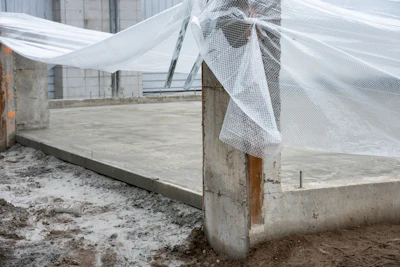
Concrete curing is now essential risk management for contractors because modern concrete mixtures with lower water-cementitious ratios, Type IL cement, and supplementary materials require precise moisture and temperature control to develop strength and durability. Inadequate curing can result in cracking, dusting, surface weakness, and permeability problems that lead to expensive callbacks and repairs, making proper curing one of the most cost-effective ways to protect profitability and ensure performance.
- Modern concrete mixtures with lower water-cementitious ratios bleed less, creating higher risk of plastic shrinkage cracking and surface drying before internal hydration completes.
- Type IL cement and supplementary cementitious materials require mixture-specific curing decisions because their reaction rates and moisture requirements differ from traditional portland cement.
- Inadequate curing causes surface weakness, dusting, reduced permeability resistance, and increased corrosion risk to reinforcing steel, often appearing as costly failures months or years later.
- Curing must begin before placement with environmental monitoring and evaporation control, not after finishing operations are complete.
- The cost of effective curing materials and labor is minimal compared to repairs, overlays, callbacks, and disputes caused by poor curing practices.
Concrete contractors have always understood that curing matters. But with the changes occurring in concrete materials and mixture design, curing can no longer be treated as simply another specification requirement to complete after finishing. It is increasingly a form of project risk management.
Modern concrete mixtures are being optimized for lower embodied carbon, higher strength, reduced permeability and longer service life. Type IL portland-limestone cement is now routine, supplementary cementitious materials (SCMs) are being used more extensively, and lower water-cementitious materials ratios are helping designers meet increasingly demanding performance requirements.
While these advances can produce exceptional concrete, they can also reduce the margin for error during placement and curing. And for contractors, this practical implication is significant.
A mixture engineered for long-term performance can still develop cracking, dusting, surface weakness or durability problems if moisture is allowed to leave the concrete too quickly. The relatively modest cost of planning and executing an effective curing program should therefore be viewed against the much greater financial exposure associated with callbacks, repairs, schedule disruptions and disputes.
 Selecting the appropriate curing method is key. The right approach depends on project requirements, environmental conditions, construction schedules and the intended service life.The Euclid Chemical Company
Modern Concrete Raises the Stakes
Curing maintains the moisture and temperature conditions necessary for cement hydration to continue. Concrete does not simply dry and become strong. Strength develops as cementitious materials react with water and form hydration products, including calcium silicate hydrate, that bind the concrete matrix together. Interrupt that process too early and the concrete may never develop the surface properties, permeability resistance or durability that the mixture was capable of achieving.
Type IL cement can perform extremely well, but contractors should not assume every cement source or mixture will behave exactly like the concrete they placed several years ago.
That becomes particularly important as water-cementitious materials ratios decrease. Low-w/cm mixtures contain less free water and typically bleed less than traditional mixtures. Reduced bleeding can provide important performance advantages, but it also means there is less water moving toward the surface to replace moisture lost through evaporation.
The surface can therefore begin drying while concrete below remains plastic. When the evaporation rate exceeds the rate at which bleed water reaches the surface, plastic shrinkage cracking becomes a concern. Low-w/cm concrete can also be more susceptible to autogenous shrinkage as hydration consumes water internally.
SCMs add another consideration. Fly ash, slag cement and silica fume can significantly improve later-age strength, permeability and durability. However, their reaction rates and moisture requirements differ from those of traditional portland cement systems. Some mixtures containing SCMs benefit substantially from extended moist curing because the reactions responsible for their long-term performance require sufficient moisture to continue.
The growing use of Type IL cement should also reinforce the importance of mixture-specific curing decisions. Type IL cement can perform extremely well, but contractors should not assume every cement source or mixture will behave exactly like the concrete they placed several years ago. Cement chemistry, SCM replacement levels, admixture packages, aggregate characteristics and environmental conditions all influence bleeding, setting, finishing and early-age moisture demand.
 Curing begins as soon as finishing operations permit to retain moisture during early hydration.The Euclid Chemical Company
The Hidden Costs of Inadequate Curing
The most obvious effects of inadequate curing often occur at the surface, where moisture is lost first.
Curing [is] one of the least expensive opportunities contractors have to reduce downstream risk.
If hydration is interrupted near the surface, the resulting paste can be weaker and more porous. On an industrial floor, that weakness may eventually appear as dusting or premature wear. Exterior concrete may become more vulnerable to scaling, freeze-thaw deterioration, or penetration by chlorides and other aggressive materials.
Cracking is another risk. Rapid evaporation during placement and finishing can contribute to plastic shrinkage cracking before the concrete has developed enough tensile strength to resist the resulting stresses. Differences in moisture content between the upper and lower portions of a slab can also contribute to differential shrinkage and curling.
Curing affects more than appearance. A poorly cured surface can develop greater permeability, creating easier pathways for water, deicing salts and chemicals to enter the concrete. Where reinforcing steel is present, that increased permeability can ultimately contribute to corrosion risk.
Strength can also be affected because hydration is directly tied to strength development. A contractor may have started with an advanced mixture designed to meet demanding specifications, but the expected performance can’t be fully developed unless curing conditions support continued hydration.
That makes curing one of the least expensive opportunities contractors have to reduce downstream risk. The cost of curing materials, blankets, water, equipment and labor is relatively small compared with grinding, coatings, overlays, crack repairs, disputed floor performance or replacement.
Choosing the Right Curing Method
First and foremost, there is no single curing method that is right for every placement.
The entire floor system should be considered before a curing product is selected.
Continuous water curing remains one of the most effective approaches because it prevents moisture loss while supplying additional water to the concrete surface. Ponding, sprinkling, wet coverings, and saturated curing blankets can all provide excellent results when maintained properly.
The challenge really lies in the execution. Water curing requires labor, access to water and procedures that keep coverings continuously wet. A wet burlap system that is allowed to dry intermittently is not the same as continuous moist curing. Large floor areas, vertical surfaces and accelerated construction schedules can also make water curing impractical.
Membrane-forming curing compounds are therefore widely used. Applied after finishing operations are complete and the surface is ready to receive them, these products form a film that restricts evaporation. They can provide an efficient curing method for large slabs and other applications where wet curing would be difficult. Their effectiveness, however, depends on application quality. Uniform coverage at the manufacturer’s specified rate is critical. Thin areas, missed sections or inconsistent spray patterns create weak points in the curing system.
Contractors should also consider what happens to the surface later. Some curing compounds may interfere with the adhesion of coatings, flooring materials, penetrating treatments or cementitious toppings. The entire floor system should be considered before a curing product is selected.
Curing and insulating blankets may be necessary where temperature control is also a concern. In cold-weather work, curing is not simply about retaining moisture. Concrete must also remain within a temperature range that permits hydration and strength development to continue.
 Environmental conditions, including cold weather, can significantly influence curing effectiveness.The Euclid Chemical Company
Control Moisture Loss Before Curing Begins
A successful curing program actually begins before curing materials are even applied. Environmental conditions should be evaluated prior to placement and monitored throughout finishing. Temperature alone does not determine evaporation risk. Low relative humidity, direct sun, and wind can rapidly increase moisture loss even on days that do not feel particularly hot.
With this in mind, contractors should be prepared to adjust placement timing, wind protection, fogging, or other procedures when evaporation conditions become severe.
Evaporation retarders can also be valuable during finishing, particularly when surface moisture is disappearing rapidly. However, an evaporation retarder should not be confused with a curing compound. It is a temporary finishing aid used to reduce rapid surface moisture loss before final curing can begin. The specified curing procedure is still required afterward.
That distinction matters because one of the most damaging curing mistakes with concrete is simply starting too late. By the time the finishing crew leaves the slab and someone begins thinking about curing, critical moisture may already have escaped.
Make Curing Part of Preconstruction
With modern concrete, the curing discussion should occur before the truck arrives.
Contractors should also understand exactly what the specification requires rather than relying on a standard procedure carried from one project to the next.
Preconstruction planning should address the mixture being supplied, anticipated bleed characteristics, environmental conditions, required curing duration, curing materials, application equipment, labor responsibilities and compatibility with subsequent flooring or coating systems.
Contractors should also understand exactly what the specification requires rather than relying on a standard procedure carried from one project to the next. A warehouse floor, bridge deck, exterior pavement and architectural wall may each require a different approach.
Most importantly, curing should be treated with the same attention given to mixture design, placement and finishing. Those operations are interconnected. There is little value in carefully selecting a high-performance concrete mixture if the moisture necessary to develop that performance is allowed to escape immediately after placement.
Modern concrete technology continues to provide contractors with stronger, more durable and more sustainable materials. But performance engineered into the mixture still has to be developed in the field. That makes curing more than a specification requirement. It is one of the contractor’s most practical tools for controlling risk, protecting profitability and ensuring that the concrete delivered to the owner performs the way everyone intended.