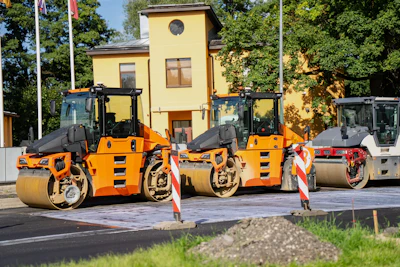
The federal government recently allocated $200 million in funding for truck parking and freight corridor projects. While important for improving roadside safety, freight efficiency and trip planning, large-scale paving operations put significant pressure on construction fleets. They will have to move large quantities of aggregate, asphalt, concrete and other materials from quarries and concrete plants to active job sites, all while maintaining uptime and equipment availability to ensure the contract is completed by the deadline.
The success of these paving projects depends, in part, on how well construction fleet managers prepare their vehicles and plan their maintenance strategies.
Spec’ing Trucks for the Work Ahead
During massive paving projects, vocational vehicles handle high-frequency, short-haul work that involves moving heavy-duty equipment and large quantities of material across rough terrains. This places every major truck component under additional stress, from tires and brakes to suspensions, cooling systems and drivetrains. Tire tread wears down more quickly, and shock absorbers deteriorate faster. In short, every part is more susceptible to wear. Preparing for these infrastructure overhauls requires fleet managers to think through a few items:
Proper specs. Defining a project’s duty cycle, payload, terrain, routes and expected job site conditions is essential during the planning stage. These conditions determine exactly what is required of a fleet for the work environment. Federal and state regulations also shape these decisions. The Federal Bridge Formula, for example, determines the allowable weight based on the number and spacing of axles. Once managers evaluate these conditions, they can begin selecting truck configurations.
Truck configurations. A poorly matched truck (that doesn’t fit the job description) will typically require more maintenance. Construction fleet managers need to verify that the units they plan to use for these projects have the capacity to perform the required work. This means considering material transportation and unloading requirements. Managers should evaluate whether the vehicles have sufficiently steep dump angles to facilitate unloading at the job site, the number of axles needed for expected payloads, if the dump bodies can handle abrasive site materials, and whether a live bottom is needed or if they’ll need to pull bottom-dump trailers.
Matching the powertrain to the application can also have a direct impact on long-term operating costs, especially when trucks will be working demanding duty cycles. Fleet managers should also understand what level of OEM support and warranty coverage is available for the configuration they select instead of looking at purchase price alone.
The materials to be transported require careful assessment. Do they need heated or insulated beds to maintain their temperature? Does the project require material that might stick to the cargo area? If so, would the vehicle benefit from a lined bed? Asking these kinds of questions can help a fleet manager match equipment to project demands.
Yet, selecting which trucks are right for the contract is only half the battle. Once subcontractors have chosen the right equipment, the next step is preparing these fleets to keep operations moving.
Preventing Downtime Before It Happens
Keeping trucks operationally ready throughout major infrastructure jobs is essential for fixed-deadline projects. The best way to maximize fleet availability is to make sure they are properly maintained.
Fleet vehicles would benefit from proactive maintenance and advanced inspection planning. This starts with comprehensive tracking. Fleet managers should log repair history and equipment status, compile performance indicators and collect trip-sheet data.
That information can also help fleets move toward more condition-based maintenance. Telematics and vehicle data can give managers greater visibility into equipment performance and help identify developing issues before they turn into more severe repairs or extended downtime.
Once vehicle performance tracking is established, fleet managers can use the information to plan out upkeep in advance. They can determine how the job's stop-and-go nature will affect brake inspection intervals and how heavy asphalt hauls increase stress on the dump body. In practice, this will lead to shorter intervals between services and more frequent oil changes, fluid level checks, brake system inspections, tire changes and battery testing.
Heavy civil subcontractors should complement this regular maintenance with pre- and post-trip inspections, so that drivers can catch any malfunctions or vehicle failures at an early stage and address them before they become larger issues. This will help get fleet vehicles back on the road and working on the project.
Taken together, self-checks and preventive services will help reduce avoidable wear and prepare fleets to respond more quickly when unexpected repairs arise.
Keeping Service Close To The Jobsite
With construction trucks under constant strain, proactive maintenance will not always be enough — fleets will still need occasional repairs. If technicians must transport a vocational vehicle over long distances for service, it diverts time from job execution. Having easy access to service and parts when incidents occur is the difference between a fleet operating at full capacity and operating one vehicle down for the duration of the project.
For these reasons, knowing the available service options in the work area is essential. Fleet managers should build those relationships before the project begins and understand what support their OEM, dealer and parts suppliers can provide if an issue occurs. Here are a couple of potential maintenance options for fleet managers to look into as they determine what is in their contracted area:
1. Mobile service. In some areas, there are services where technicians come directly to a job site. These services are helpful, as technicians can handle many wear-and-tear repairs without needing access to a shop. This service avoids towing fees and the delays of driving back and forth to a service center.
2. Dealer networks with parts availability. Construction fleet leaders should identify where the nearest dealer network is located and confirm parts availability, as this is vital to project success. These networks can offer emergency repair assistance, warranty work or certified technicians to keep fleets and paving work on track. For fleets consuming the same parts regularly, tracking usage over time can also create opportunities to plan purchases with suppliers and explore volume pricing rather than sourcing everything reactively.
By combining a proactive upkeep approach with the preemptive identification of service options, heavy civil subcontractors will have a two-pronged strategy to maximize uptime and equipment availability. This will, in turn, lend a hand to on-time paving completion.
Fleet Readiness Is Project Readiness
With the new federal funding, the upcoming paving jobs are all but certain. These projects will push construction fleets to their limits. A lack of preparation will very likely lead to increased downstream repairs and downtime. This is not sustainable for fixed deadlines.
Construction fleet managers will need to prepare their vocational vehicles before taking on a contract. This means determining the proper specs, matching powertrains to the application, configuring trucks accordingly, prioritizing proactive and condition-based maintenance and assessing service availability for the contracted area. This is how managers will bulletproof their fleets, complete paving projects on time and gain credibility that ultimately wins future contracts.