Construction fleets should treat traffic violations as serious business decisions rather than routine driver problems, because paying a citation is treated as pleading guilty, leading to insurance increases of 20-30 percent, potential CDL suspension for commercial drivers, and operational disruptions that can cost far more than the original fine.
- Paying a traffic ticket is treated as pleading guilty, creating a conviction on the driver's record that insurers can access and use to raise premiums 20-30 percent on average.
- CDL holders face mandatory 60-day suspension for two excessive speeding violations (15+ mph over limit) within three years, regardless of whether they were operating a commercial vehicle.
- Traffic violations stay on driving records for 3-5 years depending on state, affecting insurance costs, driver availability, and project schedules long after the fine is paid.
- Construction companies should implement a citation response process including prompt reporting, centralized documentation, review before paying, and pattern tracking to identify safety issues.
- Off The Record's platform connects drivers with attorneys to contest citations with a 97 percent success rate in achieving favorable outcomes that keep violations off driving records.
Construction companies are used to managing risk on the job site. Crews are trained on equipment safety, fall prevention, PPE, site access and hazard communication. But for companies that operate trucks, vans, trailers, service vehicles or heavy equipment on public roads, one major risk area often gets less attention: traffic violations.
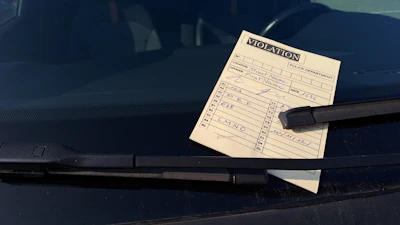
A citation may look like a driver problem at first. Someone was stopped for speeding. Someone rolled through a red light. Someone picked up a phone while driving between jobs. The driver pays the fine, gets back to work and the company moves on.
That is the mistake that can turn a routine ticket into a much bigger problem.
Here is what most people miss: paying a traffic ticket is treated as pleading guilty. The violation becomes a conviction on the driver's record, and insurers can see it. For construction fleets, that can affect insurance costs, driver availability, project schedules, safety records and workforce stability. A citation becomes a much larger operational issue when it leads to points, higher premiums, lost driving privileges or a CDL disqualification.
As construction companies rely on vehicles to keep jobs moving, traffic tickets should not be an afterthought.
The Road Is Part of the Job Site
Construction work does not begin and end at the property line.
Crews travel between projects. Supervisors drive company trucks. Concrete, asphalt, paving, utility and equipment teams move vehicles across roads and highways every day. A driver may leave one job site and immediately face a work zone, school zone, unfamiliar intersection or busy highway.
Those situations do not excuse unsafe driving. Speeding and distracted driving create serious safety risks. According to the National Highway Traffic Safety Administration, speeding was a factor in 29% of all traffic fatalities in 2024.
The point is that fleet safety cannot stop when a worker leaves the job site.
The Fine Is Only the Beginning
The number printed on a traffic citation is easy to understand. The consequences behind it are not.
Traffic tickets generally stay on a driving record for three to five years, depending on the state. And research consistently shows a single traffic ticket raises insurance premiums 20 to 30 percent on average. The impact rarely shows up immediately. A driver pays the fine today, and the company sees nothing change. Months later, that violation factors into the insurer's evaluation at renewal, and the increase follows the business for years.
There is also the operational cost.
Construction companies rely on experienced employees who know how to safely operate vehicles, transport equipment and navigate different projects. If a driver becomes unavailable because of a license or CDL issue, the company has to find a replacement, rearrange crews or adjust schedules.
That is why companies should ask a broader question when a citation arrives: What happens if we simply pay this?
The answer depends on the violation, the driver's record and the jurisdiction. The important thing is to understand those consequences, including whether there is an opportunity to contest the citation.
CDL Holders Face Higher Stakes
Unlike many industries, construction employs a significant number of drivers who hold commercial driver's licenses. Dump trucks, concrete mixers, flatbeds hauling equipment and other commercial motor vehicles all require one. For those drivers, a traffic ticket carries consequences that do not apply to ordinary motorists.
Under Federal Motor Carrier Safety Administration rules, certain moving violations can affect a driver's commercial driving record whether the driver was operating a commercial vehicle or a personal one.
Two excessive speeding violations, defined as 15 miles per hour or more over the limit, within a three-year period trigger a mandatory 60-day CDL suspension. For a driver, that can mean lost income or job loss. For an employer, it means losing a qualified CDL driver in a labor market where they are already hard to find and expensive to replace.
That does not mean every citation should be contested. It means every citation should be evaluated before deciding what to do with it. For a CDL holder, "just pay it" is never a neutral decision.
Know Your Options Before You Pay
Depending on the circumstances, contesting a citation can help keep points or a conviction off a driver's record and limit the negative effects on insurance costs, licensing and employment.
That is where attorneys and companies such as Off The Record can help. With Off The Record, drivers can submit a ticket from their phone and get matched with a local attorney in the jurisdiction where it was issued, without having to travel back to court. A favorable outcome means the ticket never appears on the driving record at all, or its impact is meaningfully reduced, such as a six-point violation knocked down to two.
Automated citations can be different. Not every camera-issued violation can be contested, but drivers should understand what options are available before deciding to pay.
For construction companies, helping drivers resolve citations can mean keeping qualified employees on the road and avoiding unnecessary disruptions to crews and schedules.
Automated Enforcement Creates a Fleet-Level Problem
Not every citation begins with an officer pulling over a driver.
Speed cameras, red-light cameras, school-zone cameras and toll systems generate citations that arrive by mail. For a company with a large fleet, that creates a problem: the company knows which vehicle was cited without immediately knowing who was driving it.
A fleet manager may need to determine which employee had the vehicle, where it was traveling, whether it was being used for work and whether the citation information is accurate.
That is where good recordkeeping becomes a risk-management tool.
Companies should be able to connect vehicles with drivers and cross-reference citations with dispatch records, vehicle logs or other available records. A centralized process prevents citations from sitting unanswered until an important deadline passes.
Tickets Are a Liability Problem, Not Just a Cost Problem
There is one more reason construction companies cannot afford to shrug off citations: what happens after an accident.
If a company vehicle is involved in a serious crash and it comes out that the business knowingly kept a repeatedly ticketed driver behind the wheel, the story stops being about one driver. It becomes a story about the company. That is a reputational problem with clients and general contractors, a legal exposure in litigation and a problem that follows the business into every future bid. When the vehicle involved is a commercial motor vehicle, the scrutiny only intensifies.
Handling citations properly, and documenting how you handled them, is how a company protects itself before it ever needs to.
Build a Citation Response Process Before You Need One
The best time to decide how a company will handle traffic citations is before the first citation arrives.
A practical fleet citation process can include:
- Require prompt reporting. Drivers should know who to notify and how quickly.
- Centralize the information. Record the driver, vehicle, date, location, violation and deadline.
- Review before paying. Determine whether the citation could affect the driver's record, insurance, license or CDL, and whether there is an opportunity to contest it.
- Give CDL citations additional attention. Commercial drivers face consequences that do not apply to ordinary motorists.
- Match automated citations to fleet records. Use dispatch, vehicle or driver records to establish who had the vehicle.
- Track patterns. Multiple violations involving the same driver, route, vehicle or conduct may reveal a larger safety issue.
- Document the outcome. Keep a record of how citations are resolved to identify trends.
The goal is not to send every ticket to court. It is to stop the company from making a consequential decision just because paying a fine feels like the fastest way to make a problem disappear.
Train for the Road, Not Just the Site
Construction safety programs often focus on what happens once workers arrive at a job site. Fleet safety needs to begin before they get there.
Driver training should address speeding in work zones, distracted driving, red-light violations, following distance, improper turns, toll violations and other rules relevant to the company's vehicles and operating areas.
Policies should also reflect the realities of construction work. Drivers may be traveling to unfamiliar sites, working under tight delivery windows or receiving last-minute instructions from supervisors.
Companies can reduce pressure by building realistic travel time into schedules, discouraging calls and messages while employees are driving and making it clear that pulling over to respond is acceptable.
A written policy is important, but a company culture that supports safe decisions behind the wheel is even more important.
Treat Traffic Citations as Business Decisions
A traffic ticket may start with one driver, one vehicle and one violation. For a construction company, the consequences can reach much further.
Insurance costs matter. Driver retention matters. CDL availability matters. Project schedules matter. Equipment and materials still have to get where they are going.
That makes citation management a business issue as much as a driver issue.
The most effective approach is straightforward: report quickly, document clearly, understand the potential consequences and make an informed decision before paying.
Construction companies already understand proactive risk management. They identify hazards before work begins, train employees to recognize danger and investigate incidents to prevent them from happening again.
The same mindset should extend beyond the job site.
And the most expensive part of a traffic ticket is often not the fine. It is what happens afterward.
Because when a construction vehicle leaves the site, the safety responsibility does not end. The road is part of the job.