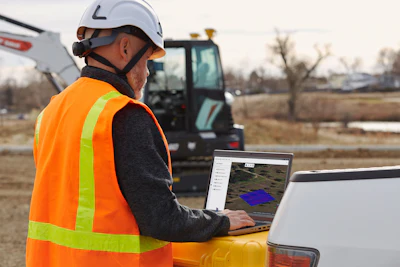
Welcome to the third part of our roundtable discussion with industry leaders in the intelligent compaction technology space. In this section we ask our panelists about the data itself. Where does it go? How can it be leveraged? And how is the data protected long-term?
Also, use these links below to jump to other parts of this round table discuss to find what you're most interested in learning about:
- PART 1: What Makes Intelligent Compaction Intelligent?
- PART 2: What Problems Does Intelligent Compaction Fix?
- PART 4: Forcasting Future Compaction Technologies.
Data, Integration, And Interoperability: Who Owns The Information?

AC: What data does your system generate during a compaction operation, and where does that data go? Walk us through the lifecycle -- from sensor capture on the machine to where it ultimately lives and who can access it.
Eric Booth, Dynapac: IC systems like Dynalyzer and Nexus share information to the cloud, so the data can be utilized at the home office for quality control purposes. The information is captured by the compaction meter (accelerometer based), the IR temperature sensors and the GPS antenna. Based on these signals, we are able to show pass mapping, temperature maps, compaction meter data (Evib-values) and compaction progress in terms of percentage. If the compaction progress shows a very low value (in percent), then it indicates that making another pass will not make much sense, since the increase in the compaction meter value was very low compared to the previous passes, so it sort of indicates to the operator if the maximum stiffness has been reached or not, i.e. it tries to predict whether an additional pass makes sense or not.
Kevin Garcia, Trimble: Compaction data generated during a pass flows into the same connected environment as the rest of the jobsite. Trimble WorksManager is the hub where design files go out to machines, as-built data comes back in, and project managers can see what's happening on the site without actually being on-site. That same flow applies to compaction data: it doesn't sit on the machine or require a manual export at the end of the day. It moves through the connected environment and lives in Trimble Connect, where it's accessible to anyone with the right access. For IC-specific analysis, that data is also compatible with VETA, the industry-accepted intelligent compaction analysis tool many agencies use.
The broader principle is that we've built Trimble Connect as an open environment. It has APIs that let contractors pull data into their own systems, combine it with information from other sources, and build the workflows that make sense for their business. Compaction data becomes part of the complete project record alongside grade control, paving, and as-built verification.
John Gravatt, BOMAG: BOMAP will record pass count, temperature, and stiffness data (depending on the options on the machine). If the customer is using the free BOMAP app without a CONNECT license, the data is stored locally on the tablet. If the customer opted for a CONNECT license in order to share and collect data from multiple machines, then the data is stored in a cloud. That data is accessible in the cloud for as long as the license is renewed. Customers can also export that data in raw CSV or VETA format. A CONNECT license also allows customers to share their data with outside users as they see fit, with an adjustable time window. Licenses are flexible and are only used when recording starts on an app, so licenses only need to be purchased for the number of machines that would be running and recording simultaneously.
Tim Kowalski, HAMM: Sensor and machine data flows into our IC software and is stored in John Deere Operations Center. Contractors can view and analyze both machine and IC data there. The contractor owns the data and may grant access to the dealer or manufacturer if desired. Data can also be converted into VETA format, which allows state agencies to review IC data using standardized software instead of multiple proprietary platforms.
Justin Zupanc, Volvo CE: With our entry level systems like Compact Assist Start, the data is for display only. It’s a lower-cost system to provide feedback to the operator on pass mapping and temperatures. Stepping up to Compact Assist and then Density Direct adds high-accuracy positioning antennas and the ability to record and export the data. This allows us to tailor the system’s performance as well as the cost to the needs of the customer.
On our Compact Assist and Density Direct systems, the operator can set up specific jobs or even lifts — whatever meets their needs — and save the results accordingly. They can create job reports automatically after a lift is completed, export data into systems like Veta, save to USB or upload over the air.

AC: Data ownership is a growing concern for contractors working with connected equipment. When a contractor uses your IC system on a job, who owns the compaction data produced -- the contractor, your company, or the agency? And what rights does each party have to that data?
Trimble: The contractor owns it. Trimble doesn't have access to the data unless the contractor decides to share it with us — that's a principle we're clear about. Job specifications will dictate what data needs to flow to the owner, and our role in that is straightforward: make it easy for the contractor to access, query, and deliver the data in whatever format the owner has requested. It's their data and their project record. We're just making it easy to work with.
BOMAG: The data, and therefore the rights to this data, belong to the companies using the application. To ensure a sustainable benefit, it is therefore even more important that the systems enable interoperability between different manufacturers and remain independent from specific vendors. With BOMAP and its open interfaces, it is possible to implement time-limited access (e.g. for clients) as well as live data transmissions. However, this always requires the consent and active participation of the construction company.
HAMM: The contractor owns the data and controls access. They may grant viewing rights to manufacturers, dealers, or agencies as needed. Agencies typically require access when the job is state-funded.
Volvo: The customer owns the machine, and the data generated is theirs. Sometimes, project requirements state that the submitted data is under the ownership of the agency requesting the work or is co-owned with the contractor. Ultimately, it comes down to the contract language.

Dynapac: The newly released Nexus system is brand-agnostic. There are sensor kits that can be placed on any brand, and the data from each can be shared in one centralized location.
Trimble: We've intentionally built toward openness. If a contractor is running a mixed fleet, their compaction data, grade control data, and as-built survey data can all live in the same project record even if not every piece of equipment is from Trimble.
Our infield solutions are also brand agnostic. A Trimble intelligent compaction system can be installed on any OEM roller. That means an operator doesn't have to learn a different IC system for each manufacturer in the fleet. One system spans all of it, whether that's a single company's mixed equipment or an entire fleet operated across multiple crews. You get continuity of training, continuity of support, and consistent data across every machine.
The ISO 15143-4 standard reinforces all of this. It establishes a common framework for cross-manufacturer data sharing, which means the interoperability conversation has moved from custom integrations to a recognized industry standard. Every contractor asking about multi-brand compatibility should be asking every vendor at this table whether their systems comply.
BOMAG: The BOMAP system can actually be used on any machine. BOMAG offers a sensor kit that includes a temperature and vibration sensor, allowing any brand machine to report into the BOMAP system with pass count (vibratory, static, or pneumatic), temperature, and CMV value.
HAMM: This capability is still under development. We recognize that contractors operate mixed-brand fleets and want centralized data access. While integration is challenging, progress is being made toward that goal.
Volvo: Compact Assist is fully integrated into Volvo CE machines, which allows us to optimize system performance, reliability and user experience. At the same time, we recognize that contractors operate mixed fleets. That’s why we focus on interoperability at the data level — supporting standard file formats and compatibility with platforms like Veta — so contractors can incorporate compaction data into their broader jobsite workflows regardless of equipment brand.

AC: The ISO 15143-4 standard for cross-jobsite data sharing was a topic at CONEXPO this year. How does your system currently align with or prepare for that standard, and what does it mean practically for contractors trying to build interoperable jobsite data workflows?
BOMAG: Yes – and we even go one step further. When taking a closer look at the requirements of the ISO standard in the context of compaction processes, it can be observed that the level of generalization in ISO 15143-4 does not provide the same qualitative basis for all types of mobile machinery.
In this context, BOMAG is pleased to be one of the founding members of MIC 4.0 and to have supported this standard from the very beginning. MIC 4.0 is an initiative that builds upon ISO 15143-4 with the aim of enabling more use-case-oriented and process-related qualitative statements. Due to its broad and generalized structure, the ISO standard leaves a certain degree of interpretation, which can lead to different implementations by OEMs and, consequently, to isolated solutions (data silos) on the user side.
The definitions developed within MIC 4.0 are not contrary to ISO but are based on it. At the same time, they go further into the specific operational areas of mobile machinery. For each machine type, main activities are defined, along with the required data fields, including detailed descriptions and specifications for measurement accuracy, such as query frequency and units.
For customers, this means clearer definitions, greater standardization, and consistent data quality and integrity across all manufacturers. Furthermore, this enables an overview of the entire construction processes, the identification of efficiency potential, and the assurance of high-quality results. Additionally, the harmonization of data—with a view to coordinating construction sites using semi-automated, highly automated, or autonomous machines—is a crucial step. We are aware of this and are therefore strongly committed to these standards.
HAMM: ISO 15143-4 enables vendor-neutral exchange of worksite data. John Deere Operations Center can import topographical data and convert it into actionable information for Wirtgen Group equipment. The technology continues to evolve, and it represents an exciting direction for the industry.
Volvo: Compact Assist is designed to ensure that the data generated is accurate, standardized and useful for the contractors and agencies requesting it. There’s no formatting necessary by an end contractor before submission, so it makes for easy integration.
Trimble: ISO 15143-4 changes the fundamental equation for how contractors build their technology stack. Until recently, achieving real integration meant committing to one vendor's ecosystem. With this standard, true plug-and-play interoperability across manufacturers is now possible, which means contractors can build best-in-class systems based on performance rather than compatibility constraints.
Practically speaking, think of jobsite infrastructure the way you think about a road pavement: sensors are the foundation, interoperability is the binding course, and the intelligence layer builds on top. If the foundation isn't solid, nothing above it performs the way it should. Compliance with that standard should be the first question contractors ask when evaluating any new technology investment. It's the difference between a system that opens up over time and one that locks you in.

AC: Machine-to-machine jobsite communication is emerging as an integration frontier. Does your system currently support that kind of cross-machine data handoff, or is that on your roadmap?
HAMM: This is an emerging priority due to mixed fleets. While it is complex, all major manufacturers are working toward solutions that benefit contractors and improve interoperability.
Volvo: We have a solution for machine-to-machine jobsite communication developed and have successfully tested it in the field, but we have not yet determined when we’ll bring it to market.
Trimble: Direct machine-to-machine communication is not a currently enabled feature of our system, but the way we've approached data access delivers something practical for contractors today. Trimble WorksManager and Trimble Connect allow anyone with approved access to see project data at any time from any connected device. A smartphone, a tablet, a web browser on a laptop in the office. We believe in connecting the data for all viewers, not just machine operators. The information isn't locked in the cab; it's available across the project.
The full cross-machine data handoff capability is on the roadmap. The foundation is already in place: the sensors are proven, the standards exist, and the connected environment is real. What comes next is building the coordination layer on top — and that's exactly where the agentic AI conversation becomes practical rather than theoretical. Machines coordinating based on shared data, rather than each operating in isolation, is the logical next step once the infrastructure is in place.
BOMAG: BOMAP does currently promote machine-to-machine communication through the connect license. This allows multiple compactors on a jobsite to contribute to a shared IC data map.
CLICK HERE for PART 4: Forcasting Future Compaction Technologies.
Meet This Year's Panelists
Justin Zupanc, Compaction Product Manager - Volvo CE North America
Justin Zupanc is a product leader with more than 23 years of experience in the off-highway equipment industry. Throughout his time with Ingersoll Rand and Volvo CE, he has built a strong foundation in engineering and product knowledge.
Justin has held a range of technical and leadership roles, including systems engineer, cab engineering manager, head of the asphalt compaction development team and head of electromobility for road products. His experience spans product development, innovation strategy and the transition to electrified equipment solutions.
Justin has a Bachelor of Science degree in electrical and electronics engineering from Penn State University and is based at the Volvo CE North American headquarters in Shippensburg, Pennsylvania.

Tim Kowalski, Applications Support Manager - Hamm, Wirtgen Group
Tim has a Bachelor of Science Degree in Construction Administration and minor in Business Management from the University of Wisconsin – Madison. He has been in the construction business for over 36 years, 16 of them working on the Quality Control of Asphalt, Aggregates, & Concrete and the last 20 on the Manufacturer side.
Tim has taught courses, made presentations, and published articles on various equipment functionality and materials topics. He is currently the ISIC NA Chapter Chairman and has served on numerous committees and task groups for NCAT, NAPA, ASTM and TRB.
Tim is the Applications Support Manager for Wirtgen America Inc. with Hamm rollers. He works closely with their District Sales Managers, Dealers & Customers throughout North America, helping them understand Hamm products and processes through mix design, equipment function and material usage to become more efficient and competitive.
Personal activities include hunting, fishing, football, snowmobiling, golf, riding Harleys and anything else that has to do with outdoor sports or activities.

John Gravatt, Product Marketing Manager - BOMAG
John Gravatt is currently a Product Marketing Manager for BOMAG Americas, where he draws on over 20 years of experience in the road construction equipment industry. After graduating from Virginia Tech with a bachelor’s and a master’s degree in mechanical engineering, he began improving designs for asphalt paving equipment at Ingersoll-Rand, and later with Volvo Construction Equipment. Joining the BOMAG team in 2023, John “went to the dark side” and began working in marketing. In his current role, John is driven by a passion to help customers build high quality, long lasting roads through the integration of the right technologies at the right time.

Kevin Garcia, General Managare of Civil Specialty Construction - Trimble Inc.
Kevin Garcia is general manager of civil specialty construction for Trimble. In this role, he is responsible for multiple product groups serving the civil specialty construction market, including paving, landfill construction, drilling and piling and more. Prior to this position, he served as paving product manager for seven years. He has more than 20 years of experience in the asphalt and concrete paving industry, including six years with Lafarge. He earned his Bachelor of Science degree in Civil Engineering from the University of Wyoming.
Eric Booth, Product Marketing Manager, Asphalt Compaction - Dynapac NA