Construction sites are busier than ever with full project pipelines, tight delivery schedules, and a workforce that's stretched thin and often less experienced. It's an environment that leaves virtually no room for safety errors, and the chance of a misstep has never been higher.
The business case follows naturally. Research from the National Safety Council puts the indirect costs of a workplace injury at three to ten times the direct costs. Those don't arrive as a single invoice. They bleed into the P&L disguised as missed deadlines, turnover, and contracts that go to someone with a cleaner safety record. Adding to the challenge, insurance and surety carriers are tightening underwriting standards.
The real value of technology in this environment lies in the data it generates, insight that keeps safety decisions grounded in field reality rather than assumption. The challenge for many is to harness that data and connect it directly to day-to-day work.
 Trimble Inc.
Less Time, Less Risk
The ongoing labor shortage is an operational challenge and a safety multiplier. Industry forecasts suggest contractors need to attract nearly 500,000 net new workers in 2026 alone. Many will be placed into fast-paced, high-risk environments before they've developed the situational awareness that comes with experience.
In the concrete space, that gap shows up in specific ways: crews working close to the slab in finishing operations, formwork and shoring that demands exacting attention, cast-in-place work where the margin for error is slim and rework is never without risk. From a safety standpoint, one of the most effective things technology is already doing is reduce the amount of time people spend in those situations.
GNSS-enabled equipment eliminates the need to send workers onto the ground near active equipment and traffic. For concrete site prep and flatwork, grade checking happens without putting people in the path of moving machinery. When a blade can do the checking, the crew stays clear.
String lines are another example. They've been part of jobsites for so long that crews often stop seeing them as a risk, but they're a genuine tripping hazard, especially at the end of a long shift. With the machine knowing exactly where it needs to be, the wire simply isn't needed anymore.
And when teams get the work right the first time — with millimeter-level guidance rather than a guess-and-check approach — there's no need to return to potentially dangerous situations for corrections.
Laser scanning reinforces this on complex concrete structures. On Denver's One River North, a 16-story cast-in-place building with a challenging canyon-inspired exterior, general contractor Saunders Construction used scanning to reduce the chance of rework. The firm's safety director Justin Tourdot made the connection plainly: "Rework continues to be a leading precursor for injuries in the construction industry. Utilizing the latest scanning technologies resulted in reduced errors and rework, which is ultimately safer for all workers." Fewer corrections mean fewer trips back into conditions that have already been cleared once.
Mmanaging the controlled intensity of a pour … is a real backstop for even the most experienced operators.
Guided Backstops
A second category of technology works differently, not by removing hazards but by supporting the operator through the shift itself.
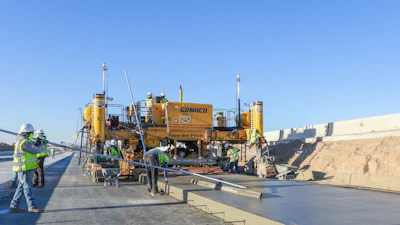
Automatic steering on pavers is a good example. The machine stays on its defined path without constant correction, which frees the operator to watch haul trucks, monitor the crew, and stay alert to what's happening around them. It's the same principle behind automotive driver-assist technology: when the machine handles routine corrections, the operator arrives at the end of a long shift with more energy and sharper awareness.
Emerging avoidance zone technology adds a more active layer. Virtual geofences built into 3D guidance systems trigger visual and audible warnings when equipment moves toward unsafe areas such as exposed utilities, excavation edges, or zones where finishing crews are working. For concrete contractors managing the controlled intensity of a pour, where equipment and workers are sharing the same space under time pressure, that automated awareness is a real backstop for even the most experienced operators.
Safer by Design
Some of the most valuable improvements come from a digital workflow that gives crews visibility into conditions they simply couldn't see before.
Infrared cameras on pavers monitor mat temperature in real time. The primary use is quality control, but the crew welfare application is just as important. Knowing when workers are on hot surfaces, and tracking how long they've been there, gives supervisors the data to make informed decisions about rotation and rest.
Integrated maintenance platforms work similarly. Proactively scheduling equipment service and tracking repair history means machines get attention during planned downtime rather than failing unexpectedly mid-pour. On a concrete jobsite, an unplanned equipment failure puts people in situations that planned workflows are specifically designed to avoid.
Drone-based aerial capture has become standard practice for good reason. What once required survey crews to navigate active work zones for days now happens in hours from above. The data quality keeps improving, and the logic is straightforward: fewer people in hazardous areas means fewer opportunities for something to go wrong.
 Trimble Inc.
The Dynamics of Data
One pattern shows up on jobsites more often than anyone likes to admit: incidents, near-misses and equipment defects that occur but are never documented or not documented thoroughly and immediately because crews are stretched thin, working to a tight schedule or don't have effective reporting tools. Digital platforms built into daily field workflows mean that reporting happens in the moment, recorded immediately on a tablet or phone, rather than relying on memory and paperwork at the end of a long day.
Contractors who have made that move consistently note that connected, site-focused reporting changes how data gets collected and, more importantly, how it actually gets used. Instead of sorting through handwritten forms days after the fact, managers can identify trends in real time, reference past data without manual effort, and respond to emerging concerns before they become incidents. When field logs, safety and inspection forms, and incident reports flow through integrated platforms, safety information stops being a separate administrative task and starts flowing like any other project metric.
That kind of connected reporting changes how safety is managed on the jobsite and how the business performs beyond it. Digital data, for example, is reshaping routine jobsite safety tasks, starting with equipment inspections. Instead of paper forms that may get lost or delayed, crews can complete inspections quickly on a phone or tablet, often in real time. That convenience means inspections are more likely to happen as scheduled, with issues reported immediately and repairs initiated quickly instead of days later. Digital forms can also be tailored to specific equipment, prompting more thorough checks. In many cases, digital inspection forms connect directly to maintenance systems, automatically triggering work orders or alerts so problems are addressed without delay.
Software for equipment maintenance brings automation to the preventive maintenance workflow, tracking utilization metrics and then notifying teams when preventive service is due. This proactive approach reduces unexpected breakdowns and helps resolve issues before they create safety risks, leading to a more stable and predictable jobsite environment.
Beyond equipment, digital tools are improving how safety is documented and managed overall. Incidents and near misses can be reported on the spot, creating a more accurate record of jobsite conditions. Training materials and compliance requirements are easier to distribute and track. Most importantly, digital records make it possible to analyze trends and identify recurring risks. Instead of reports sitting unused, teams can take informed action. Even time tracking tools can capture safety data, bringing visibility and accountability into everyday workflows.
Contractors who have made the digital connection aren't waiting for the next incident to tell them where the gaps are; the data is already telling them.
The Business Advantage
The contractors seeing the most meaningful improvements are building connected systems where safety information flows across every phase of the project. Clean digital records of inspections, near-miss reports, and maintenance workflows translate directly to better insurance terms and a stronger position when competing for work that demands a demonstrable safety record.
Contractors who invest in preventing recordables protect more than their safety record. They protect their schedule, their workforce, and their ability to bid for the next job. As these tools become more connected, the data they generate is beginning to do something more powerful.
The next frontier is predictive. AI is already proving its value in construction workflows by accelerating processes like point cloud classification and feature extraction that once required hours of skilled work, and getting teams from raw survey data to usable models faster. That same capability, applied to safety data, could compare incident patterns across multiple projects faster than any manual review. Mobile mapping solutions with high-resolution LiDAR are already incorporating AI-driven workflows for road condition evaluation, automatically identifying surface issues before they become hazards. The technology is still developing and human judgment remains essential, but the direction is clear: the feedback loop between field conditions and safety decisions is getting shorter, and the focus is shifting from what went wrong to what's likely to go wrong next.
What technology changes is the speed and clarity of that feedback loop: how quickly a pattern becomes visible, how fast a supervisor can respond, and how much of the risk can be anticipated rather than absorbed. Contractors who have made the digital connection aren't waiting for the next incident to tell them where the gaps are; the data is already telling them.