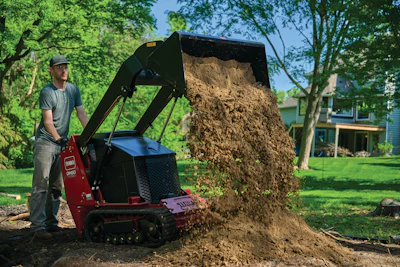
Today’s jobsites demand more productivity from fewer people, tighter spaces and smaller margins for error. That’s why compact utility loaders (CULs) have become a go-to workhorse for jobs of all sizes and complexity. Small enough to access confined areas yet powerful enough to handle demanding tasks, CULs deliver versatility that makes them a valuable asset on any rental yard.
From landscaping and hardscaping to utility installation, demolition, earthmoving and general construction, CULs can be outfitted with a wide range of attachments to tackle almost any application. They’re also a major productivity booster — moving material efficiently, reducing manual labor and freeing up crew members for higher value work (not to mention saving a few backs in the process).
CULs bridge the gap between manual hauling methods like wheelbarrows and larger equipment classes such as skid steer loaders and compact track loaders. Compared to larger machines, CULs offer better visibility and maneuverability, intuitive controls and easy on and off access — features that matter most on tight or congested jobsites.
The Rental Provider’s Role
For rental customers, the value of a CUL isn’t just the machine, it’s the expertise behind the counter. As the provider, your role is to help match customers with the right equipment for their specific job.
Start by asking three simple questions:
- What tasks will you be performing?
- Is there a specific lift height you need to reach?
- How heavy are the materials you'll be hauling?
As the provider, your role is to help match customers with the right equipment for their specific job.
From there, you can help narrow down their needs based on rated operating capacity (ROC). Consider the following common scenario: A landscaping contractor plans to move pallets of block through a gated backyard and assumes a skid steer is required. By asking a few targeted questions, you steer them toward a higher ROC CUL that fits through the gate, minimizes turf damage and completes the job faster — without over renting the machine. That guidance builds trust and repeat business. The Toro Company
500–550 lbs. ROC: Best for close-quarter jobs such as backyards with gated access, trenching near tight property lines or working in confined spaces. Some units in this class are electric, and the quieter operation and reduced engine emissions make them a strong choice for interior demolition and construction jobs.
700–1,000 lbs. ROC: For more power while still maintaining a small footprint. Units in this class are a solid fit for general landscaping and residential construction — augering post holes in tough clay or rock, moving pallets, leveling ground and the like.
1,300–2,000 lbs. ROC: Built for jobs that need extra power and expert maneuverability. These machines have the ability to lift as much as many skid steers but with the added advantage of better visibility, a more nimble design and minimal ground disturbance. Units in this class are ideal for hauling stone or wall blocks, rough grading, large-scale planting and breaking up thick asphalt and concrete.
 The Toro Company
Attachment Versatility
Once power needs are defined, attachments unlock the true versatility of a CUL. While options vary by make and model, many machines can be equipped with multiple attachments to handle different phases of work.
Common options include:
- Bucket: Load and lift gravel, dirt, sand and other materials
- Soil Cultivator: Level soil, blend materials and bury debris
- Power Box Rake: Prepare seedbeds and sod by cutting high spots and removing debris
- Auger: Dig fence posts and utility holes
- Floor Scraper: Break up flooring materials for interior demolition
- Forks: Move pallets, posts, rocks and trees
- Grapple Rake: Grab, lift and remove branches, or other materials from a jobsite
Helping customers choose the right attachments often allows them to complete multiple tasks with a single rental.
The real differentiator is the expertise that helps customers choose correctly.
The Bottom Line
Whether a customer is tackling a weekend landscaping project or managing a large construction job, there’s a compact utility loader built for the task. The real differentiator isn’t just the equipment — it’s the expertise that helps customers choose correctly.
By understanding the work being done, the materials being moved and the space the machine will operate in, rental providers can match customers with the right CUL and attachments. That leads to safer operation, better productivity and stronger customer loyalty — value that keeps renters coming back.