Construction waste provides valuable data about procurement, installation practices, and labor productivity that can reveal costly inefficiencies and help contractors improve project profitability by analyzing patterns in what materials are discarded and when.
- Waste costs extend beyond disposal: Materials incur costs multiple times through purchasing, transportation, labor handling, and installation before reaching the dumpster.
- Procurement patterns matter: Excess unused materials, recurring damage, and large packaging volumes signal ordering problems, poor storage practices, or mismatched material dimensions.
- Installation waste reveals problems: Patterns like excessive lumber offcuts or drywall scraps indicate inefficient design specifications, sequencing issues, or handling problems.
- Timing provides context: Comparing waste spikes with labor hours, deliveries, and schedule progress helps distinguish between normal production increases and actual problems.
- Historical data improves estimates: Tracking waste across multiple projects creates accurate disposal budgets and material quantities for future bids rather than relying on industry assumptions.
Construction companies spend a great deal of time studying what comes onto a jobsite. Materials are estimated, purchased, scheduled and delivered, while equipment utilization, labor hours and project schedules are tracked closely. Yet there is another source of information sitting on nearly every construction project that receives far less attention: what is leaving the site.
A dumpster filled with lumber, drywall, packaging, conduit, pallets or other construction materials is usually viewed as a disposal issue. Once the material goes into the container, the objective is simply to get it off the site as efficiently and economically as possible. But those discarded materials can provide valuable information about procurement, installation practices, scheduling, material handling and labor productivity, all of which have a direct impact on project profitability.
For contractors looking for incremental improvements in margins, construction waste deserves a closer look. The opportunity is not simply to spend less on hauling or divert more material from landfills. It is to understand why materials are being discarded in the first place and what that can tell you about the way the project is being managed.
Waste Costs More Than the Disposal Bill
Most contractors understand the direct cost of construction waste because it appears clearly on project financials. There is a charge for the container, another for transportation and often a tipping fee based on weight or material type. Those expenses can add up quickly, particularly on large projects, but they represent only the final costs associated with discarded material.
Consider a load of lumber delivered to a jobsite. The contractor paid for the material and its transportation, and workers were paid to receive, unload and move it to where it was needed. Carpenters then spent time measuring and cutting it, after which someone had to collect the leftover pieces, move them to a dumpster and eventually pay another company to haul them away.
By the time excess material leaves the site, a contractor may have spent money on it several times without receiving any productive value from it. That changes the financial conversation around waste. Instead of asking only how much the company is spending on dumpsters, contractors should also be asking why those materials ended up there and whether some of those costs could have been prevented upstream.
Look at the Purchasing Process
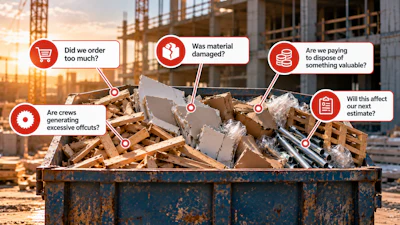
Consistent waste patterns can provide an early indication that procurement practices need attention. Large quantities of unused or lightly used material may mean too much was ordered, while recurring damage could indicate that materials are arriving too early or are not being stored properly. In other cases, standard order quantities or material dimensions may simply be a poor match for what crews actually need in the field.
Packaging can reveal similar inefficiencies. Pallets, cardboard, plastic wrap, crates and other shipping materials are necessary for getting products safely to a project, but large volumes of packaging also require workers to handle them and contractors to remove them. Looking at which suppliers and deliveries generate the most material can open conversations about consolidated shipments, reusable containers or alternative packaging.
These may sound like relatively small operational adjustments, but construction margins are often determined by exactly those kinds of details. A few unnecessary pallets or sheets of material will not make or break a project, but repeated inefficiencies across hundreds of deliveries and multiple jobs can become meaningful. Waste data provides another way to identify those costs rather than accepting them as an unavoidable part of doing business.
What Installation Waste Can Tell You
The contents of a dumpster can also provide clues about what is happening during installation. A high volume of short lumber offcuts, for example, may indicate that the lengths being purchased do not align efficiently with field requirements. Excess drywall scraps might point to opportunities to reconsider board sizes or layouts, while large amounts of damaged material could indicate problems with storage, handling or sequencing.
The important word here is "patterns." A single dumpster containing an unusual amount of material does not necessarily indicate a problem, and contractors should be careful not to draw conclusions from isolated incidents. When the same types of materials are repeatedly discarded at similar points in a project, however, the information becomes much more useful.
That information can also help project managers ask better questions without immediately assuming there is a labor problem. Increased waste might result from a design condition, specification, change order, procurement decision or installation method. The discarded material is not necessarily the problem itself; it is a signal that gives the project team another place to investigate.
Timing Can Be as Important as Volume
Construction projects have predictable rhythms as trades mobilize, deliveries arrive and different phases of work accelerate or wind down. Waste generation tends to follow those activities, which means the timing of material leaving the site can provide additional context about project performance.
An unexpected spike in dumpster volume, for example, may correspond with increased production and therefore be completely reasonable. It could also indicate damaged material, rework, a design revision or an unexpected change in installation practices. Without visibility into what is being discarded and when, those distinctions are difficult to make.
The real opportunity comes from comparing waste activity with information contractors already collect. Labor hours, schedule progress, material deliveries, equipment utilization and project costs all provide pieces of the operational picture. Adding material waste to that dataset can help project teams identify unusual activity earlier rather than discovering the financial impact weeks later when updated cost reports are reviewed.
There May Be Value Leaving the Site
Another question contractors should ask is whether everything being hauled away actually belongs in the waste stream. Depending on the project, some materials may be reusable, recyclable or valuable in secondary markets. Certain wood streams can also have value as feedstock or for energy recovery where appropriate infrastructure exists.
This matters from a profitability standpoint because disposal is generally a cost center. If a contractor can reduce the amount of material requiring conventional disposal, there may be an opportunity to lower hauling and tipping costs. On large projects producing significant material volumes, even modest reductions in disposal expenses can become meaningful.
Capturing that value requires knowing what is leaving the site. When everything goes into mixed dumpsters and disappears with limited tracking, contractors lose the ability to evaluate alternatives. Better material visibility allows project teams to determine whether a different destination makes financial and operational sense rather than automatically treating every discarded material as garbage.
Use Today's Waste to Improve Tomorrow's Estimate
Perhaps the biggest opportunity emerges when contractors begin looking at waste data across multiple projects rather than one job at a time. Historical information can help companies understand what normal material loss looks like for different project types and where actual performance routinely differs from estimating assumptions.
A contractor that has completed 20 similar projects should theoretically be able to answer questions such as how much lumber waste those projects typically generate, how many containers are required during different phases and which materials produce the greatest disposal costs. Companies can also compare projects to identify whether certain designs, suppliers, installation methods or project conditions consistently generate more waste.
That information can eventually make its way back into preconstruction. Instead of relying solely on standard waste factors or industry assumptions, estimators can incorporate the company's own historical performance into material quantities and disposal budgets. The estimate becomes more accurate because it reflects what actually happened in the field, creating a feedback loop between completed projects and future bids.
Treat the Dumpster as Another Source of Jobsite Data
Construction companies are already becoming more sophisticated about collecting operational data. Equipment telematics can show utilization and idle time, project management platforms track schedules and costs, and cameras and other technologies provide increasingly detailed visibility into jobsite activity. Material leaving the project should be considered another part of that information environment.
That does not mean contractors need another complicated dashboard or another set of reports for project managers to review. The value of data depends on whether it helps someone make a better decision. Waste information is useful when it helps a contractor order more accurately, reduce unnecessary handling, identify recurring installation problems, lower disposal costs or improve the assumptions going into the next bid.
For decades, the construction industry has largely treated the dumpster as the end of the process. Material goes in, a truck hauls it away and the project moves forward. From an operational standpoint, however, that dumpster contains a record of dozens of decisions that were made before the material ever reached it.
As margins remain tight and contractors look for every reasonable opportunity to improve productivity, those decisions are worth examining. The next source of useful project intelligence may not come from another software platform or management report. It may already be sitting at the edge of the jobsite, waiting to be hauled away.